
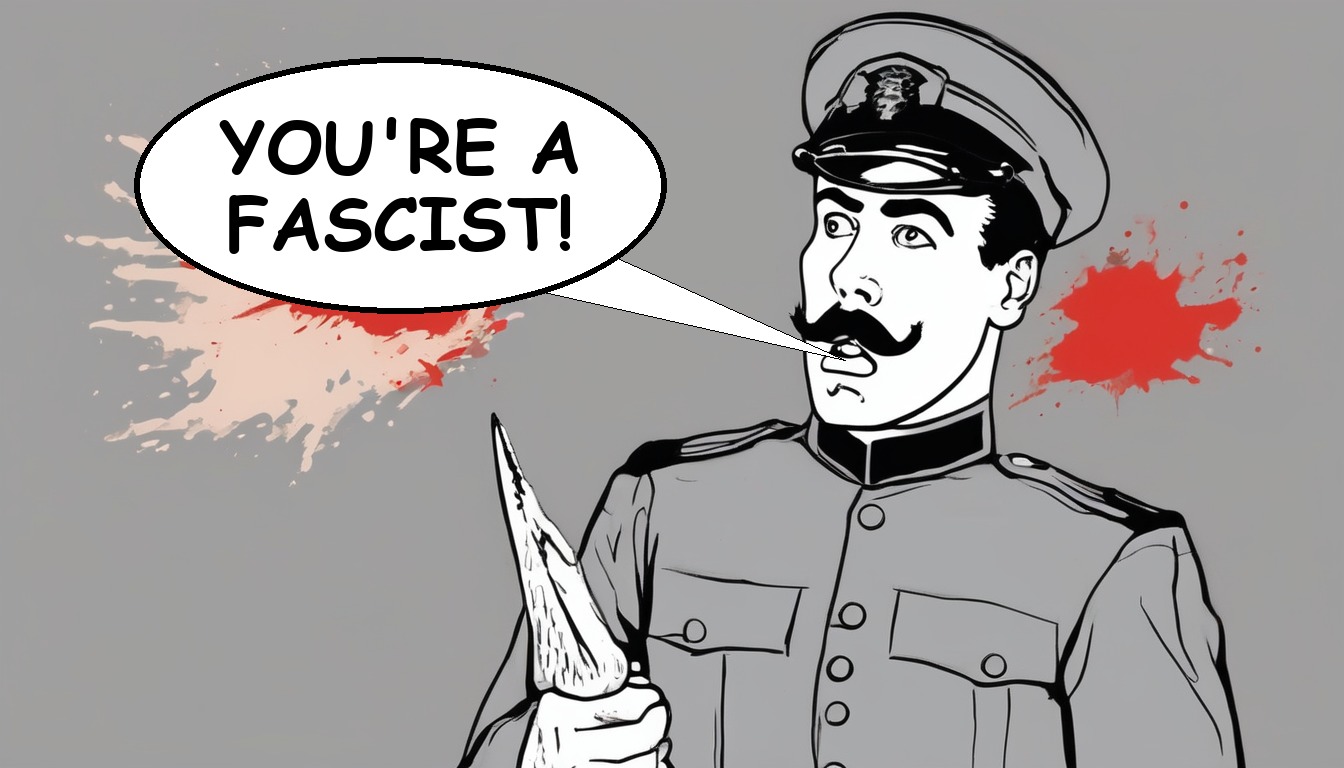
Fascism was never defined by its flag. It was defined by its methods: the mob, the intimidation, the silencing of dissent, the capture of institutions, the insistence that only one opinion may be spoken aloud.
So here is a simple test. Ignore what people call themselves. Ignore the labels they pin on everyone else. Watch what they actually do.
Because in Britain today, the people shouting “fascist” the loudest have a habit of behaving like the thing they claim to fight:
- Hiding behind a peaceful symbol. Take a flag or a word associated with peace and resistance, and fly it over conduct that is anything but.
- Attacking your own country’s culture. Teaching people to be ashamed of the place they call home.
- Attacking your own country’s history. Not studying it, not learning from it — erasing it.
- Pulling down statues. The mob decides, the rope comes out, and centuries of history go in the harbour.
- Blockading political rivals’ meetings. If you can’t win the argument in the room, stop the room from meeting at all.
- Intimidating venues. Ringing round every hall and hotel so that opponents cannot even hire a room. Ordinary people never see it happen — they just never hear the other side.
- Cancel culture. Not disagreement — punishment. Careers, reputations and livelihoods destroyed for holding a lawful opinion.
- Going after livelihoods. Ringing a person’s employer because of something they said in their own time. That is not activism; it is economic intimidation.
- Debanking. Weaponising banks and payment services so dissenters can’t hold an account, take a donation, or run a campaign.
- Doxxing. Publishing home addresses and workplaces so “someone else” will do the intimidating.
- Masked street mobs. Dressing in black, covering your face, and turning up to “counter-protest” with fists and bike locks — then calling it self-defence.
- Using the tools of the state to oppress and intimidate. When officialdom investigates opinions instead of crimes, the state has picked a side.
- Two-tier treatment. One policing standard for their marches, another for everyone else’s.
- Using front groups to attack political rivals. Keep your own hands clean; let the “spontaneous” mob do the work.
- Screaming “Nazi” at any other opinion. When every farmer, fisherman, veteran and worried parent is a “fascist”, the word means nothing — except “be quiet”.
- Eroding free speech and independent thought. Not by argument, but by consequence — until people learn to say nothing, and eventually to think nothing.
- Turning fact into fiction. Things every generation before us knew to be true are suddenly “contested”, “problematic” — or forbidden. When you must deny the evidence of your own eyes, you are not in a debate; you are in a re-education programme.
- Arresting journalists. Reporters detained, raided and dragged through the courts for reporting the wrong story — in a country that lectures the world about press freedom.
- Ignoring crimes against the “wrong” victims. When whole categories of victims are looked away from for years because acknowledging them is politically inconvenient, that is not sensitivity. It is complicity.
- Policing language itself. Redefining ordinary words until ordinary opinions become unsayable — then punishing the “offence” they just invented.
- Outsourcing the censorship. Branding dissent “misinformation” or “hate” so that tech platforms and regulators do the silencing at arm’s length.
- The forced public apology. Not persuasion — recantation. The struggle session, updated for social media.
- Capturing the institutions. Schools, universities, the arts, the civil service — then enforcing conformity from the inside and calling it neutrality.
- Accusing rivals of exactly what they are doing. Every one of the tactics above gets projected onto their opponents. The louder the accusation, the better the mirror.
Where have you seen these actions before?
None of these methods are new. Every single one has been tried before — and history recorded exactly where they lead.
1930s Germany. Street mobs breaking up rival meetings. Uniformed gangs “counter-protesting” with fists. Books burned, art purged, academics dismissed, newspapers brought to heel. The state deciding which opinions were criminal — and neighbours denouncing neighbours.
Soviet Russia. Fact turned into fiction as a matter of state policy. History rewritten edition by edition; the disgraced airbrushed out of photographs. Journalists arrested. Yesterday’s truth made tomorrow’s crime — and everyone made to applaud the change.
Mao’s Cultural Revolution. Statues toppled, temples smashed, the “Four Olds” — old customs, old culture, old habits, old ideas — hunted down by student mobs. Teachers and writers paraded in struggle sessions and forced to confess. A country taught to despise its own past.
East Germany. A network of informers reporting on colleagues and family. Careers quietly ended for the wrong opinion. And the detail that says it all: the regime’s official name for the Berlin Wall — built to imprison its own people — was the “Anti-Fascist Protection Rampart”.
Every one of those regimes claimed to be protecting the people from fascism, from reaction, from dangerous ideas. The label was always virtuous. The methods were always the same.
This is a playbook — and it has worked before
Put the pieces in order and you can see it is not a coincidence. It is a sequence. Capture the language, so some things become unsayable. Capture the institutions, so the unsayable becomes unteachable and unemployable. Capture the past, so no one can point to how things used to be. Then criminalise what dissent remains — and let the mob deal with whoever is left. The Germans had a word for the institutional stage: Gleichschaltung — “bringing into line”. Orwell put the historical stage in nine words: who controls the past controls the future.
None of the regimes above announced themselves as tyrannies. Each arrived step by step, wearing the language of protection and progress, applauded at every stage by people who thought it could never go further. By the time it was obvious where it led, pushing back had become dangerous. That is why the time to push back is now — while it is merely expensive.
And the pushback must be everything the playbook is not: lawful, peaceful, open and democratic. Speak plainly. Defend those punished for lawful opinions. Ask questions in public. Organise. Stand for election. Vote. The playbook’s first move is always to take those tools away from you — which tells you exactly how much they matter.
None of this is the behaviour of people confident in their arguments. Confident people debate. They persuade. They put their case to the voters and accept the result.
Real tolerance is being disagreed with — sometimes profoundly — and reaching for a better argument, not for the rope, the mob, or the phone call to your employer.
GB Freedom will always defend free speech, open debate and the right of every lawful voice in this country to be heard — including the voices we disagree with. That is the difference. That has always been the difference.
And don’t lose heart. They are a minority — a loud one, but a minority. Movements built on these methods always fail in the end. And when this one fails, its members will do what they always do: deny they were ever part of it, and quietly hope everyone forgets.
Anyway — we are quite sure that once these people read this and realise they are on the wrong side of history, all of this nonsense will stop immediately.
Judge people by their methods, not their slogans. Fascism is as fascism does.
